


Esta web utiliza cookies para que podamos ofrecerte la mejor experiencia de usuario posible. La información de las cookies se almacena en tu navegador y realiza funciones tales como reconocerte cuando vuelves a nuestra web o ayudar a nuestro equipo a comprender qué secciones de la web encuentras más interesantes y útiles.
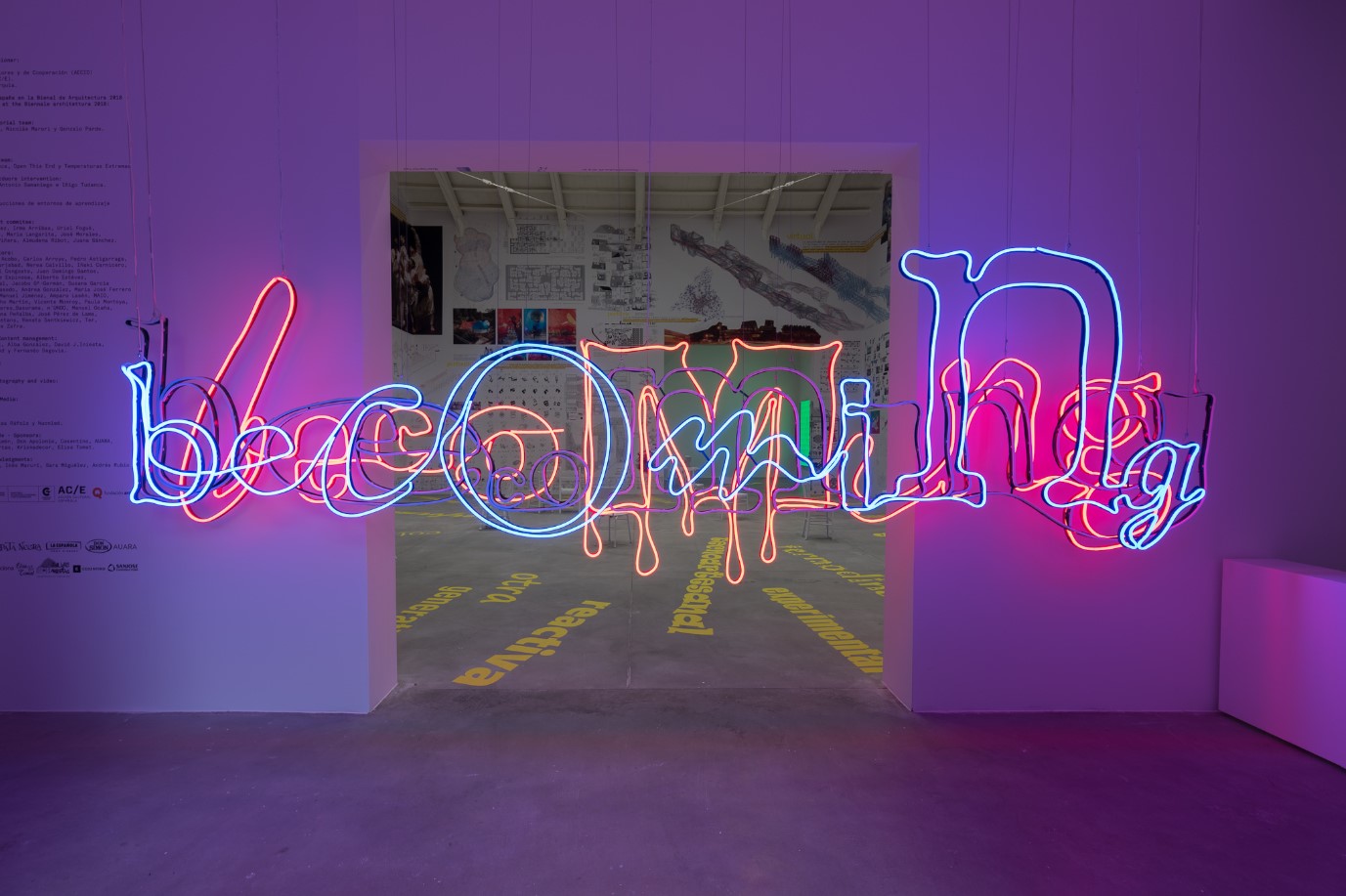
The Spanish Pavilion at the 16th International Architecture Exhibition – La Biennale di Venezia presents its central theme: becoming. Along with co-curators María Mallo, Gonzalo Pardo, Andrés Cánovas, Nicolás Maruri, the pavilion explores the future of the field of architecture by way of its display of students’ proposals and research. The installation presents numerous innovative concepts and designs, all drawing from the theme of FREESPACE. According to La Biennale di Venezia:
“Freespace refers to generosity, focusing on the quality of space itself; to the contribution or gift of an additional free space to inhabitants; to the unexpected in each project independent of its diverse restrictions. To the use of the virtues of nature, the generation with a new way of thinking, where architecture provides well-being and dignity. To the possibility of imagining free space of memory and time, uniting past, present and future.”
becoming addresses the past, present, and future of the architectural discipline. The pavilion questions and critiques the history of learning environments, analyzes current trends of education and training in schools, and inspires a future of education that crosses paths with other disciplines, including sustainability, social justice, and virtual reality. Above all, the Biennial provides a stage in which architects can tackle seemingly insurmountable issues using society in a design-forward, innovative techniques.
After winning the Golden Lion award for Unfinished at the Biennale Architettura in 2016, the Spanish Pavilion switched gears in 2018 to include innovative technological features. In collaboration with Bestario data visualization studio, five projects in the pavilion are presented in augmented reality.

Another innovation conceived in the Spanish Pavilion is the (in)temporary garden. The proposal of the garden recognizes the spontaneity of nature and the possibility of natural, autonomous life without intervention by humans. During the Biennial, the interactive garden allowed visitors to plant seed balls. The garden will be abandoned until the next Biennial—when visitors and students will finally rediscover the fruits of their labor.
Through this interactive piece, contributing architects, students, and visitors alike received the opportunity to participate and contribute to the pavilion. In a sense, all passive viewers became invested in the outcome of the (in)temporary garden, embodying the the title of becoming.
Among its many notable proposals, a group of students opted to transform the space that was previously used for storage behind the pavilion. Consisting of a large metal frame and wispy metal curtains, the Come-In Project presents a group of ideas that guide the conceptual framework of the pavilion. The piece installed was a reflection of the most important qualities of this Biennial:
… affective, affirmative, assembled, atmospheric, augmented, biodigital, caring, collaborative, cosmopolitical, critical, cross border, day to day, disruptive, emerging, experimental, extra-terrestrial, feminist, generative, human, hybrid, inclusive, independent, inform(ation)al, magical, multiple, narrative, networking, other, participatory, perfectible, performative, peripheral, playful, political, post-produced, programmed, prototyped, reactive, reused, sampled, sexy, social, strategic, sustainable, synchronized, techno-crafty, temporary, thermodynamic, topological, transdisciplinary, transformable, transmaterial, uncertain, unfinished, virtual…

Unlike other solitary pavilions, in the Out of the Box Celebration, the Pavilions from Spain, Belgium, and Holland joined forces to present the Europa installation. From over 100 ideas, the winning proposal was installed between the three countries’ pavilions. The winner, a group of Belgian students, aimed to unite the three countries by undermining the very concept of separated pavilions.
becoming challenges our notions of the past, present, and future of architecture education through its analysis of past and present techniques of education. The pavilion embraces the idea of interaction between viewer and art, allowing its participants and visitors to contribute to the creation of architectural and natural design. And perhaps most importantly, it rejects the separation of national pavilions by openly collaborating with other countries in the Europa installation. Through these themes, the Spanish Pavilion is becoming an important feature in the 16th International Architecture Exhibition.
__________
The Biennale Architettura 2018 is open to the public from May 26 to November 25, 2018.
16th International Architecture Exhibition—La Biennale di Venezia Curators: Yvonne Farrell and Shelley McNamara; Director: Paolo Baratta. La Biennale Architettura 2018 will present 100 participants, 63 international collaborations, 12 collateral events and two special projects.